The Debt That Disciplines: Predatory Lending, Poverty Architecture, and the Fight for Worker Power
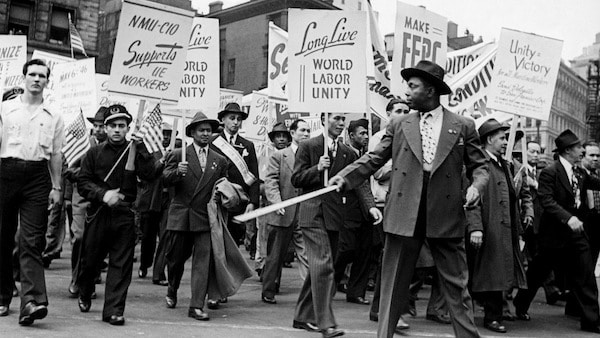
May Day began as a demand for time. In 1886, workers across the United States walked off the job to demand an eight-hour workday; the principle that a person's life should not be consumed entirely by labor. But underneath that demand for time was a deeper demand for dignity: the insistence that work should lead somewhere. That promise, that work means something and that it yields something beyond exhaustion, is the moral foundation of the labor movement. And nearly 140 years later, it is being broken in ways the original marchers could not have anticipated.
Today, one of the most effective tools for keeping workers precarious and unable to build has nothing to do with the factory floor—It is predatory lending. And it functions not as an unfortunate byproduct of poverty, but as part of the architecture that builds and maintains poverty by design, an architecture that ensures work, for millions of people, leads nowhere at all.
What Poverty Architecture Means
We tend to talk about poverty as though it were simply the absence of money; a deficit that can be corrected by adding income, opportunity, or financial literacy. But poverty is better understood as a condition maintained by interlocking systems: housing, employment, credit, law, and public investment, all interacting to keep people in place. Predatory lending is one load-bearing wall in that structure. And the scale of that wall is measurable.
Consider what it means in terms of the dignity of work. The typical payday loan borrower earns about $30,000 a year. Eighty-one percent work full time. These are not people who have opted out of the labor force. They are workers; employed, showing up, clocking in. And yet 58 percent of them report difficulty meeting basic monthly expenses. Seven in ten use payday loans not for emergencies but for recurring costs: rent, utilities, groceries, car payments. The loan is not supplementing their income in a crisis. It is filling a structural gap between what their labor pays and what their lives cost.
The price of filling that gap is staggering. The average payday loan borrower takes out $375 and pays $520 in fees; more in interest than the original loan. A single repayment consumes 36 percent of the borrower's gross paycheck, even though research shows most can afford no more than 5 percent while still covering basic expenses. The result is predictable: 80 percent of payday loans are taken out within two weeks of repaying a previous loan. The average borrower is indebted for five months of the year on what was marketed as a two-week product.
Multiply those individual losses across the population and the extraction becomes visible at a systemic level. In 2022 alone, payday loan borrowers in states that permit high-cost lending took out over 20 million loans totaling nearly $8.6 billion, and paid an estimated $2.4 billion in fees, according to the Center for Responsible Lending. That $2.4 billion is money earned by working people and transferred to lenders. It is not reinvested in the communities where it was earned. It is extracted from them.
So how does the mechanics of these payday loan traps work?
The products vary, payday loans, auto title loans, high-fee installment products, rent-to-own contracts, but the logic is shared. They target people with limited access to conventional credit and impose terms that make repayment difficult or impossible on schedule. Revenue comes primarily through fees, penalties, and refinancing cycles rather than through the productive use of capital. The borrower pays more for less. The lender profits most when the borrower cannot escape. These products are engineered to capture people at moments of vulnerability, a medical bill, a car repair, a gap between paychecks, and convert that momentary need into a durable financial obligation. This is not a market failure. It is a market functioning exactly as designed. The borrower works to pay the lender. The lender profits from the gap between what the work earns and what the debt costs. The dignity of the labor is stripped at the point of extraction.
And payday loans are only part of the picture. Approximately 62 million Americans are unbanked or underbanked, meaning they rely on alternative financial services, check cashing, money orders, prepaid cards, just to access the wages they have already earned. These households pay hundreds of dollars annually in fees for basic transactions that banked households receive for free. In 2020, financially vulnerable households paid an estimated $255 billion in interest and fees on everyday financial services; nearly 85 percent of all such fees paid that year. That is the poverty tax: not a line item on a pay stub, but a constant, quiet siphoning of wages into a parallel financial system designed to profit from exclusion.
The community-level effects compound. Research on fringe banking has found that payday lender owners typically reside outside the neighborhoods where their businesses operate, meaning capital flows out of the community with each transaction. Academic studies have documented associations between payday lender density and increased financial hardship, higher crime rates, and even elevated premature mortality in surrounding neighborhoods. When mainstream banks avoid low-income areas, creating what researchers call "banking deserts", predatory lenders fill the vacuum, and the gap between communities with tools for wealth-building and communities with tools for wealth-extraction widens.
Storefronts fill with extraction-based businesses. Wealth flows out. Disinvestment follows. The neighborhood becomes legible to outside institutions only as a risk, which then justifies further exclusion from affordable credit, completing the cycle. The National Community Reinvestment Coalition has documented this pattern going back decades: formerly redlined neighborhoods still receive fewer mortgage loans than comparable non-redlined areas, and the disinvestment persists into the present.
This is not incidental. It is architectural. The poverty is not prior to the lending. The lending helps produce and reproduce the poverty.
The Racial Geography of Extraction
The racial dimension of predatory lending is not secondary. It is foundational.
The modern predatory lending industry was built on the scaffolding of redlining, racial covenants, and decades of exclusion from conventional financial services. When mainstream banks refused to serve Black and Latino communities, alternative financial services filled the vacuum; not as a corrective, but as a second extraction layered on top of the first.
The subprime mortgage crisis made this visible at national scale. Black and Latino borrowers with credit profiles that qualified them for conventional loans were systematically steered into subprime products. The resulting foreclosure crisis destroyed an estimated $200 billion in Black household wealth. Entire neighborhoods were hollowed out. The recovery that followed largely bypassed the communities that were hit hardest.
But the pattern did not begin or end with mortgages. Payday lenders, auto title lenders, and high-cost installment lenders concentrate their operations in Black and Latino neighborhoods at rates that cannot be explained by demand alone. Research has consistently found that race and ethnicity are leading factors in determining where payday lenders locate. The density of predatory lending outlets in communities of color is a spatial expression of structural racism; profit extracted along the same lines that exclusion was once enforced.
The work was never the problem. The architecture around the work, who is allowed to benefit from it, and who is allowed to profit from the fact that they cannot, has been the problem all along.
A Case Study in Regulatory Failure: The Carolinas
If you want to see poverty architecture operating in real time, look at the border between North Carolina and South Carolina.
North Carolina became the first state in the country to ban payday lending, passing legislation in 2001 that capped interest rates at 36 percent APR on small-dollar loans. Georgia followed in 2004, imposing a 10 percent APR cap and making predatory high-cost lending a felony. Virginia enacted significant reforms. Even within the broader South, states like Kentucky imposed moratoriums on new payday lenders.
South Carolina did none of these things. The state imposes no meaningful limits on the rates that supervised lenders can charge. People in South Carolina regularly pay interest rates between 200 and 500 percent.
The result was not the disappearance of predatory lending in the region. It was its geographic concentration. When neighboring states closed their markets, the industry relocated, consolidated, and set up shop in South Carolina, particularly in border towns along the I-77 and I-95 corridors. Fort Mill, North Augusta, Dillon: these communities became extraction zones, drawing borrowers from states that had decided to protect their residents from exactly these products.
The numbers are staggering. In a single year, roughly 900 South Carolina payday and auto-title lenders made more than a million loans, with borrowers paying an average annual percentage rate of 390 percent on loans of less than $400 taken out for two weeks. The state's own Department of Consumer Affairs documented individual interest rates as high as 850 percent, a figure so extreme that the agency contacted the lenders to suggest they consider lowering the rate. Not to mandate it. To suggest it.
That the state's regulatory response to an 850 percent interest rate was a suggestion rather than an enforcement action tells you everything about the political economy of lending in South Carolina.
The industry's political power in the state is proportional to its roots there. Advance America, one of the largest payday lending companies in the country, is headquartered in Spartanburg and operates thousands of offices across 29 states. Fair lending advocates have described the difficulty of moving reform legislation through the Statehouse, noting that lenders provide substantial campaign funding to elected officials and hold significant political capital.
And the communities that bear the cost, disproportionately Black, disproportionately low-income, disproportionately military-connected, are the same communities whose labor, whose land, and whose political exclusion built the regional economy in the first place. The extraction is not new. The instrument is.
What May Day Demands Now
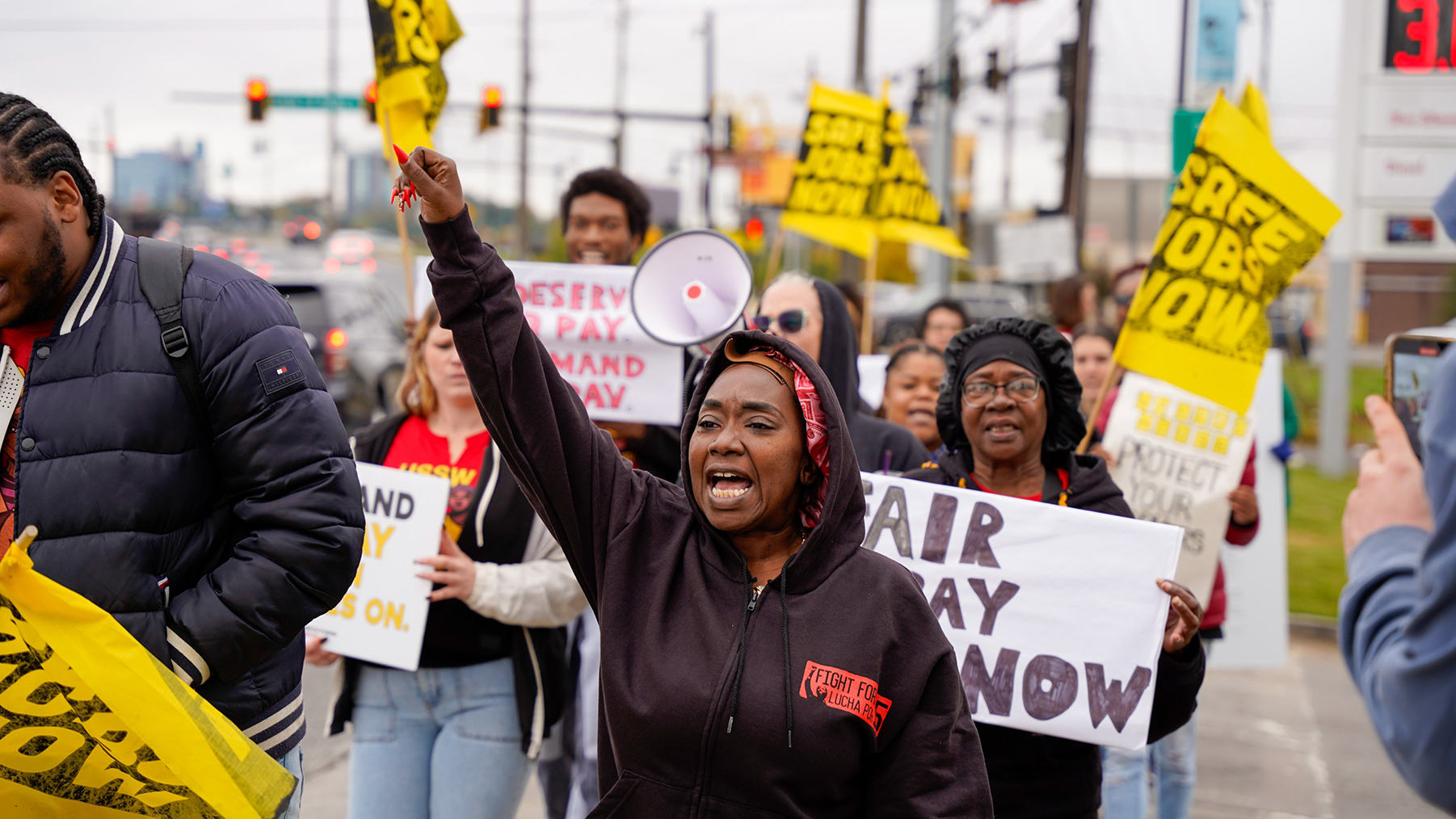
The predatory lending industry is an assault on the idea that labor should have dignity. It consumes the wages workers have already earned, converting labor into debt service, converting vulnerability into revenue, converting communities into extraction zones.
And it disciplines. A worker trapped in a cycle of debt is a worker whose wages are spoken for before they are earned, who has less ability to refuse bad conditions, less ability to organize, less ability to hold out during a strike. Debt narrows the range of choices a worker can make until compliance is the only option left. The original May Day marchers understood that time was a site of exploitation. Today, debt serves a parallel function. It compresses the horizon. And we have been trained to see it as a private failing rather than a structural condition with structural beneficiaries. Predatory lending does not just follow low wages. It reinforces them.
If the labor movement and philanthropy are serious about worker power and poverty, they have to contend with this system; not downstream, through financial literacy and emergency assistance, but structurally, through advocacy, regulatory reform, and investment in alternative financial infrastructure. A worker free from predatory debt is a worker whose labor belongs to them.
The same communities that were excluded from fair wages, from union protection, from land ownership, and from political representation are the communities that now pay 391 percent interest on a two-week loan. That fact is not a coincidence. It is the architecture. And until we tear it down, the promise that labor carries dignity will remain, for too many people, a promise broken before the first shift ends.